Insight
What is AI SOC? Explanation of How It Works, Differences from Traditional SOC, and Benefits of Implementation
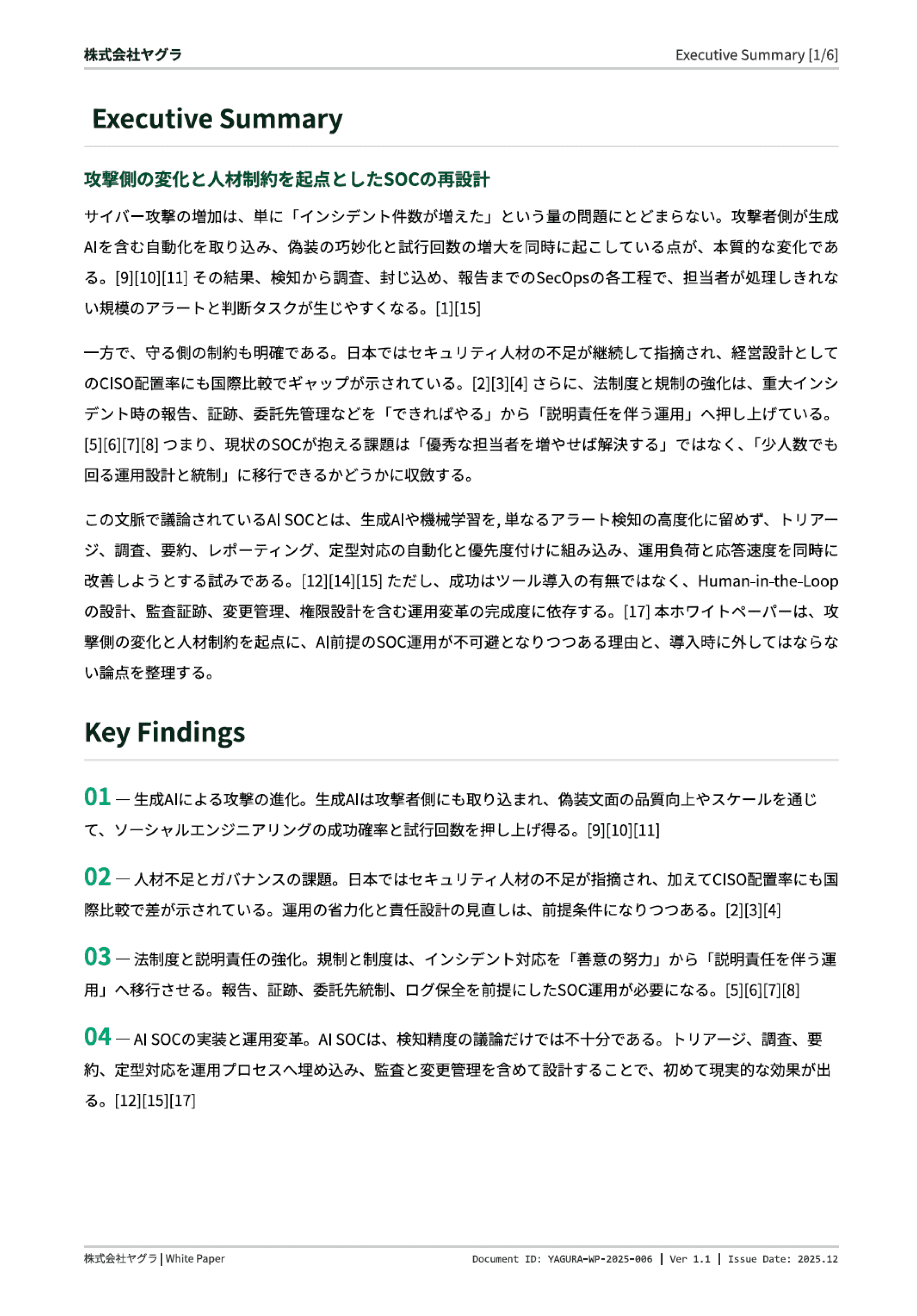
An AI SOC is a security operations framework that leverages AI to support alert investigation, analysis, and response. This article explains how it differs from SIEM, SOAR, and MDR, the scope of automation versus human judgment, its benefits, and key selection criteria.

Updated: September 17, 2026. Added examples of investigating suspicious sign-ins and confirmation items for SCS evaluation preparation.
AI SOC vs. SIEM: Where to Start?
If your logs are scattered across different products, making it difficult to gather the necessary information for investigations, first establish a foundation for log collection, storage, and search. If you are already receiving alerts from EDR or SIEM but your team lacks the bandwidth to investigate them all, consider AI-assisted primary triage.
Centralize and analyze logs: Review SIEM Mechanics, Costs, and Selection to define collection targets, retention periods, and operational structures.
Streamline alert investigation: Confirm which logs the AI SOC can access, its reasoning criteria, and the threshold for handoffs to human analysts.
Outsource response post-detection: Separate investigation from actual response actions, and define who approves containment/isolation, weekend/night contacts, and recovery owners.
SIEM and AI SOC are often used together. Rather than choosing based on product names alone, identify whether your bottleneck lies in gathering data, analyzing it for decision-making, or approving and executing responses to easily compare required features.
Vendor Evaluation Checklist
Test using your own alerts to verify if you can trace back to raw logs, if the system flags insufficient data for pending decisions, and if your team can determine next steps from English reports. Measure "Investigation Completed" and "Response Completed" separately, and track the number of human overrides of AI conclusions along with the time spent on deeper investigations.
For specific features, refer to Yagura AI SOC. To evaluate fit for your environment, schedule an AI SOC Consultation. Below is a detailed breakdown of the underlying mechanics and how they differ from adjacent security services.
In modern security operations, the volume of alerts generated by EDR (Endpoint Detection and Response) and SIEM (Security Information and Event Management) is surpassing human processing capacity. Maintaining a 24/7/365 monitoring structure solely with human analysts requires significant headcount and budget. Consequently, many organizations default to having daytime analysts review only high-severity alerts as time permits. Addressing this structural challenge is "AI SOC," where autonomous AI agents handle investigation and response.
This article defines AI SOC, explains its mechanics, highlights differences from traditional SOCs, MSSPs, and SOAR, and outlines the benefits and considerations for organizations, drawing on public research data. For a baseline on security operations, see What is a SOC? Roles, Tier Structures, 24/7 Operations, and Limits.
What is AI SOC?
AI SOC (AI Security Operations Center) refers to a security operations model, or a category of products and services, where autonomous AI agents powered by generative AI handle core tasks like alert monitoring, triage, assessment, and initial containment. These software entities are called "AI SOC agents." Their key differentiator is that they replicate the workflows of human analysts—gathering related logs, distinguishing normal from malicious activity, assessing severity, generating reports, and initiating isolation—by asking the same analytical questions.
Terms like "AI SOC," "AI SOC Agent," "Agentic SOC," and "Autonomous SOC" are used interchangeably as industry definitions evolve. The common denominator is that AI has shifted from a mere "detection aid" or "co-pilot assistant" to an "autonomous investigator" that delivers conclusions and evidence. Thus, AI SOC does not replace the security operations center itself; rather, it shifts the operational model from labor-intensive triage to human-AI collaboration.
Key Differences from "AI Detection" and "AI Assistants"
AI has been used in security tools for years. Machine learning for anomaly detection (UEBA) and AI-driven malware analysis focus on improving detection accuracy. Recent generative AI security assistants (co-pilot models) help summarize logs or write search queries, but they still require a human analyst to initiate actions.
In contrast, an AI SOC agent acts on alerts autonomously. It plans the investigation, retrieves data from EDR, SIEM, identity providers, and threat intelligence, tests hypotheses, and delivers conclusions. This autonomy (completing triage without human intervention) and continuous learning (tuning itself to the environment) are the core differences. For more on this concept, see our article The Era of Agentic AI SOC: Augmenting, Not Replacing, Analysts.
Scenario: Investigating a Suspicious Sign-in with SIEM and AI SOC
Here is a hypothetical scenario to illustrate how these systems interact during a late-night incident involving a suspicious sign-in, privilege modification, and bulk file downloads.
Role of SIEM: Correlates logs for authentication, privilege changes, and file operations for the target user and timeframe, organizing them into a chronological timeline.
Role of AI SOC: Gathers supporting evidence from authorized data sources, compares the activity with historical baselines and device context, and outlines anomalies, normal patterns, and gaps in information (subject to integration scope and permissions).
Role of Human Analyst: Confirms if the activity was a pre-approved task or business travel, decides on account suspension based on business impact, and documents the execution and recovery outcomes.
When evaluating these solutions, look beyond natural language readability. Confirm if you can trace back to raw logs, if the tool highlights missing evidence, and if humans can override decisions. Use the AI SOC Selection & PoC Checklist alongside SIEM Mechanics, Costs, and Selection to evaluate collection foundations and triage automation independently.
AI SOC for SCS Evaluation Preparation
Purchasing security tools is not enough to prove compliance with SCS frameworks. You must verify that required logs are retained, define who reviews alerts, and ensure notification and response logs are audited. For the complete framework, see the SCS Evaluation Overview, and use the SCS Evaluation Checklist to map roles, logs, and timelines. Note that deploying an AI SOC does not guarantee compliance certification on its own.
How AI SOC Works: 4 Steps from Alert to Response
While workflows vary by product, AI SOC operations typically follow these four steps:
Step 1: Alert Ingestion - Automatically ingests alerts from EDR, SIEM, cloud infrastructure, identity providers, and email security via APIs or connectors. Yagura AI SOC integrates with over 100 security products, maximizing value from your existing security investments.
Step 2: Autonomous Investigation - The AI agent replicates advanced analyst workflows, asking: "Is this process legitimate?" "What is the parent process?" "Is this login typical for this user at this hour?" "What is the reputation of this external IP?" "Are other endpoints showing similar behavior?" It queries logs and aligns findings with the MITRE ATT&CK framework to map attacker tactics (MITRE, accessed 2026).
Step 3: Assessment and Reporting - It classifies alerts as True Positive, False Positive, or Needs Review, producing a natural-language report with clear reasoning so human analysts can verify results quickly.
Step 4: Containment and Mitigation - Executes responses like endpoint isolation, account disabling, or IP blocking based on pre-authorized rules or upon human approval. Organizations can scale automation based on risk tolerance.
Context Memory: Tailoring Protection to Your Environment
Unlike static automation, AI SOC uses "context memory" to learn from investigations and human feedback. It recognizes unique environment patterns—such as a weekly IT maintenance script, a specialized department tool, or regular remote admin access—to minimize false positives and improve investigation accuracy over time. Yagura AI SOC uses context memory to adapt to your network, improving performance the longer it runs.
EDR/SIEM Integration and Execution Foundations
AI SOC works alongside detection tools like EDR and SIEM. SIEM provides the necessary log data for investigations and acts as an orchestration platform for response. For instance, Microsoft Sentinel is a cloud-native SIEM that delivers scalable, cost-effective security across multi-cloud environments, combining AI, automation, and threat intelligence to support detection, hunting, and playbooks (Microsoft Learn, accessed 2026). Yagura AI SOC integrates with existing tools like Microsoft Sentinel, allowing you to automate operations while preserving your Sentinel architecture. Learn more in Maximizing Microsoft Sentinel with AI SOC.
AI SOC vs. Traditional SOC, MSS/MDR, and SOAR
Understanding how AI SOC fits alongside existing security operational models is key. Below is a comparison with in-house tier-based SOCs, outsourced MSSP/MDR services, and SOAR playbooks.
vs. Traditional Tier-Based SOC
Traditional SOCs organize analysts into Tier 1 (alert triaging), Tier 2 (incident analysis and response), and Tier 3 (threat hunting and forensics). This model faces scaling issues: Tier 1 workloads grow proportionally with alert volumes, requiring round-the-clock shifts. Consequently, alerts go unreviewed or weekend triage is delayed.
AI SOC offloads Tier 1 triage to software, allowing human analysts to focus on Tier 2 and Tier 3 tasks. Humans move from manual sorting to validating AI findings and tuning detection logic. For more details on analyst burnout, see The SOC Analyst Shortage and "Alert Fatigue".
vs. MSS/MDR
MSS (Managed Security Service) and MDR (Managed Detection and Response) are practical options for outsourcing 24/7 monitoring. However, traditional MSSPs often rely on generic monitoring rules that ignore local context, introduce latency in communication, and charge extra for out-of-scope investigations.
AI SOC uses an on-premises or cloud-based AI agent that learns local environment context to triage alerts instantly. These approaches can be complementary: MDR providers can leverage AI SOC to scale services, or an internal SOC can use AI for primary triage while keeping external experts on standby for complex incidents. Compare these models in MDR, MSS, XDR, and AI SOC: Key Differences.
vs. SOAR
SOAR (Security Orchestration, Automation, and Response) automates tasks like data enrichment and endpoint isolation using pre-configured "playbooks." Gartner defines core SOAR capabilities to include manual and automated triggers to assist analysts, and highly customizable workflow management (Gartner Peer Insights, 2024). While effective for predictable tasks, SOAR requires high maintenance and struggles with unexpected scenarios.
AI SOC agents dynamically formulate investigation plans based on the alert context instead of relying on rigid playbooks. It determines what information is missing and queries sources on the fly. In practice, AI agents can handle triage and decision-making while SOAR playbooks execute the containment commands. Learn more in SOAR vs. AI SOC.
Benefits and Key Considerations of AI SOC
Business Outcomes: Coverage, MTTR, and Resource Efficiency
The value of AI SOC is measured across three primary metrics: coverage, response speed, and operational efficiency.
Increased Alert Coverage - AI-driven triage helps organizations scale coverage to alerts that would otherwise go unreviewed due to resource constraints. Yagura AI SOC supports security teams in this capacity. Real-world coverage depends on your integrations and alert volumes, which should be assessed in your specific environment.
Reduced MTTR - Mean Time to Respond (MTTR) is a critical SOC performance indicator. Yagura AI SOC accelerates analysis to help security teams make faster containment decisions. When optimizing your response pipeline, measure triage and resolution phases independently to locate bottlenecks like approval delays.
Operational Efficiency - Yagura AI SOC automates repetitive triage tasks to reduce team workloads. By identifying which tasks can be automated and which require human review, you can redirect analyst time toward threat hunting, custom detection engineering, and executive reporting.
To assess ROI, compare pre- and post-deployment metrics under identical alert conditions. Industry data supports the financial benefits of security automation. According to IBM’s "Cost of a Data Breach Report 2026," the global average cost of a data breach reached $4.99 million (a 12% increase year-over-year), yet organizations leveraging security AI and automation extensively saved an average of $1.93 million compared to those that did not (IBM, 2026). For metric design, see MTTR and MTTD: Designing and Improving SOC KPIs.
Considerations: Human-in-the-Loop, Explainability, and Tool Integration
Design Human-in-the-Loop Safeguards - AI SOC deployments typically start with human validation for all AI assessments. As confidence grows, teams can automate false-positive closure and low-risk mitigations. High-impact actions like endpoint isolation usually retain a human approval step. NIST’s SP 800-61 Rev. 3 guidelines recommend integrating incident response within broader CSF 2.0 risk management frameworks (NIST, 2025), meaning automated actions must align with your established risk policies.
Ensure Explainability and Audit Trails - Understanding why an AI reached a conclusion is vital for operations and compliance. Transparent audit trails reduce validation times and help meet reporting requirements in regulated industries.
Leverage Existing Infrastructure - AI SOC sits on top of your current stack. Verify product compatibility, log forwarding requirements, and data privacy policies with your existing EDR and SIEM tools.
Avoid "Agent Washing" - As agentic AI interest grows, Gartner predicts that over 40% of agentic AI projects will be abandoned by late 2027 due to rising costs, unclear business value, or poor risk management, warning buyers against "agent washing"—where vendors market standard automation as autonomous agents (Gartner, 2025). When selecting an AI SOC, run a proof of concept (PoC) using your own alerts to verify reasoning depth. See our checklist in Choosing an AI SOC: PoC Evaluation Criteria.
The Strategic Value of AI SOC
Addressing the Cyber Security Talent Gap
The cybersecurity talent shortage is a persistent global issue. According to the ISC2 "2024 Cybersecurity Workforce Study," the global cybersecurity workforce gap reached approximately 4.76 million professionals, a 19.1% increase year-over-year, with 90% of respondents reporting skill gaps in their security teams (ISC2, 2024). Gartner similarly identifies this shortage as a key driver for security service spending (Gartner, 2024).
Team burnout remains high. A Tines "Voice of the SOC 2023" survey found that 63% of SOC professionals experienced burnout, and 55% considered leaving their jobs within the year, though 93% agreed that automation would improve their work-life balance (Tines, 2023). In regions where recruiting dedicated 24/7 security staff is difficult, AI SOC offers a practical way to scale operational capacity using existing personnel.
Defending Against AI-Driven, 24/7 Threats
The IPA "10 Major Information Security Threats 2026" report ranks ransomware and supply chain attacks as top threats, with AI-related cyber risks entering the top three for the first time (IPA, 2026). Police Agency reports show ransomware incidents remaining high, with small-to-medium enterprises (SMEs) accounting for 60% of victims. Recovery costs frequently exceed $70,000, with many attacks targeting unpatched VPN devices outside business hours.
Attackers are also utilizing AI. IBM reports a 56% increase in AI-engineered attacks (IBM, 2026), and Gartner predicts that generative AI attacks will comprise 17% of total cyber incidents by 2027 (Gartner, 2024). Because automated attacks occur around the clock, defenders require automated triage and containment capabilities. For more on this challenge, see The Hurdles of After-Hours Security Coverage.
Meeting Regulatory and Audit Demands
Regulated industries like finance and defense manufacturing face strict security monitoring and incident response mandates. Attempting to meet these requirements through manual tracking can consume significant administrative overhead. An AI SOC automatically logs investigation steps and decision paths, helping organizations maintain compliance records and prepare for audits. Industry requirements are detailed in Security Operations for Financial Institutions and Defense Supply Chain Security and SOC Standards.
Frequently Asked Questions
Q1. Does AI SOC replace human analysts?
No. AI SOC handles initial alert triage and routine containment—the most time-consuming parts of the workflow. Human analysts are still required for final incident verification, exception handling, custom detection engineering, threat hunting, and executive communications.
Q2. Do we need to replace our current EDR or SIEM?
No. AI SOC runs on top of your existing detection tools. Yagura AI SOC is a proprietary service that integrates with over 100 security products, including Microsoft Sentinel, allowing you to build on your current security stack.
Q3. How do we manage the risk of AI misclassifications?
We recommend starting with a human-in-the-loop validation model, gradually automating low-risk responses as you verify accuracy. Verify that the tool provides transparent reasoning, uses context memory to suppress repeated false positives, and integrates human approvals for high-impact actions. Read more in Automating Alert Triage.
Q4. Is AI SOC suitable for mid-sized organizations?
Yes. Mid-sized organizations that cannot support a dedicated, round-the-clock security team often benefit most. AI SOC allows you to maintain continuous triage coverage using your existing EDR/SIEM tools. Review implementation steps in SOC Deployment Steps and Costs.
Summary
AI SOC automates EDR and SIEM alert triage, investigation, and containment using autonomous agents. It shifts security operations from manual sorting to human-validated decision-making. Unlike static SOAR systems or traditional outsourced services, it runs 24/7/365, adapts to your environment context, and processes alerts at machine speed.
Successful adoption requires defining human approval gates, verifying explainability, integrating with existing tools, and validating agent capabilities. As talent shortages persist and threats accelerate, AI SOC offers a scalable path to improve security operations. For security terminology, see our glossary: SOC (Security Operations Center).
Related Service: Learn how Yagura AI SOC delivers 24/7 autonomous alert triage and containment.
References
IPA 10 Major Information Security Threats 2026 (2026): https://www.ipa.go.jp/security/10threats/10threats2026.html
IPA 10 Major Information Security Threats 2025 (2025): https://www.ipa.go.jp/security/10threats/10threats2025.html
National Police Agency Cyber Threat Report (2026): https://www.npa.go.jp/publications/statistics/cybersecurity/data/R7/R07_cyber_jousei.pdf
ISC2 2024 Cybersecurity Workforce Study (2024): https://www.isc2.org/Insights/2024/10/ISC2-2024-Cybersecurity-Workforce-Study
IBM Cost of a Data Breach Report 2026 (2026): https://www.ibm.com/reports/data-breach
Tines Voice of the SOC 2023 (2023): https://www.tines.com/reports/voice-of-the-soc-2023/
Gartner Predicts Over 40% of Agentic AI Projects Will Be Canceled by End of 2027 (2025): https://www.gartner.com/en/newsroom/press-releases/2025-06-25-gartner-predicts-over-40-percent-of-agentic-ai-projects-will-be-canceled-by-end-of-2027
Gartner Forecasts Global Information Security Spending to Grow 15% in 2025 (2024): https://www.gartner.com/en/newsroom/press-releases/2024-08-28-gartner-forecasts-global-information-security-spending-to-grow-15-percent-in-2025
Gartner Peer Insights: Security Orchestration, Automation and Response Solutions Market Definition (2024): https://www.gartner.com/reviews/market/security-orchestration-automation-and-response-solutions
NIST SP 800-61 Rev. 3: Incident Response Recommendations and Considerations for Cybersecurity Risk Management (2025): https://csrc.nist.gov/pubs/sp/800/61/r3/final
Microsoft Learn: What is Microsoft Sentinel? (Accessed 2026): https://learn.microsoft.com/en-us/azure/sentinel/overview
MITRE ATT&CK (Accessed 2026): https://attack.mitre.org/