Insight
Automating Alert Triage: How AI Agents Conduct Initial Investigations with Guaranteed Accuracy

Transform alert triage—the most time-consuming task for SOCs—from traditional rules, correlation analysis, and SOAR to automated primary investigations using AI agents. This session practically explains investigation workflows, accuracy mechanisms to prevent false positives and missed threats, and how to start deployment with shadow operations.
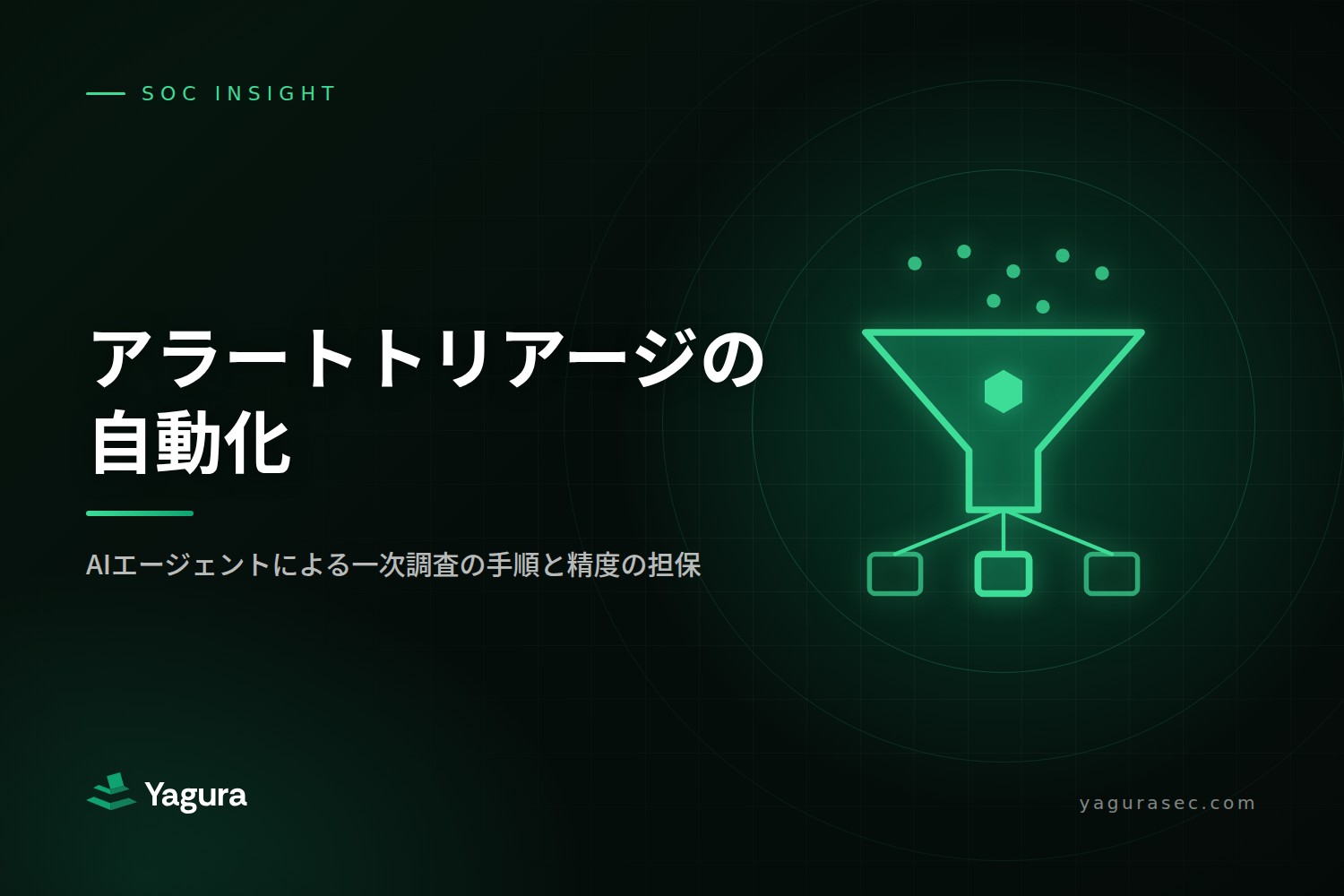
In SOC operations, the task consuming the most time is not the analysis of sophisticated attacks, but the daily triage of incoming alerts. Many alerts generated by EDR and SIEM are false positives or duplicates, but there is no way to know which are genuine without investigating. Analysts work under the dilemma of not being able to review everything, yet not being able to afford missing a real threat. If this continues, it leads to alert fatigue and high turnover rates.
In a survey of 900 security practitioners across the US, UK, and Europe, 63% reported experiencing burnout, with "spending too much time on manual tasks" cited as the top frustration (53%). Simultaneously, 93% agreed that "increased automation would improve work-life balance" (Tines Voice of the SOC, 2023). Triage automation is no longer just about efficiency; it is becoming a prerequisite for maintaining sustainable monitoring operations.
This article breaks down alert triage to the operational level of Tier 1 analysts, examines the progress and limitations of traditional automation using rules, correlation analysis, and SOAR playbooks, and then outlines the primary investigation steps using AI agents, frameworks to ensure accuracy, and deployment strategies.
What Is Alert Triage? Breaking Down the Tier 1 Analyst Role
The term "triage" originates from emergency medicine, referring to the prioritization of patients based on severity. In a SOC, alert triage refers to reviewing alerts from detection systems, separating threats that require action from those that do not, prioritizing critical issues, and escalating them to the next responder. In a tiered SOC, Tier 1 analysts typically handle this primary triage, while Tier 2 and Tier 3 analysts take over for deeper investigation and containment. If incident detection is the phase of "noticing" an event, triage is the phase of "deciding how to handle what was noticed."
This process is clearly defined in industry standards. NIST SP 800-61 Rev.3, published in April 2025, organizes incident response in alignment with the Cybersecurity Framework (CSF 2.0). It recommends performing a "preliminary review of new incident reports to confirm that an incident occurred and estimate its severity" (RS.MA-02), and "prioritizing response speed based on scope, estimated impact, urgency, and available resources" (RS.MA-03). It also notes that when declaring an incident, organizations should "account for known false positives" (DE.AE-08) and base triage, prioritization, and escalation decisions on a set of risk assessment factors (NIST SP 800-61 Rev.3, 2025). The document also states that because the volume of potentially harmful events is generally extremely high, organizations must rely on technical solutions to filter massive event data down to a human-reviewable scale. The concept that humans cannot manually review every alert is already built into industry standards.
The Five Phases of Triage
The workflow of a Tier 1 analyst reviewing a single alert can be broken down into five main steps:
Deduplication: Grouping multiple alerts generated by different products for the same event, or repeated detections on the same host, to reduce the overall volume of alerts to review.
Contextualization: Correlating IP addresses, hostnames, users, and hash values in the alert with asset data (criticality, owner department, external exposure), user attributes (role, permissions, typical working locations/hours), and threat intelligence.
Verification: Analyzing gathered information to determine if the alert represents a real threat (true positive), a false positive from normal business activity, or a malicious event that has already been remediated.
Prioritization: Determining urgency based on the scope of impact, proximity to critical assets, and the attack stage, then setting the queue order according to SLAs.
Escalation: Routing confirmed threats to higher-tier analysts or incident response teams, complete with supporting evidence and recommended remediation steps.
While this process seems routine, it actually involves continuous decision-making—determining what information to retrieve and when enough evidence is gathered to make a decision. The variance in analyst experience directly impacts decision quality. Microsoft Learn documentation notes that "process standardization" is one of the most critical elements of effective security operations, ensuring that incidents receive the same treatment and SLA regardless of who is on shift, and that defining these procedures is the responsibility of SOC managers and senior (Tier 2/3) analysts (Microsoft Learn). The ultimate goal of triage automation is to enforce this standardization without relying on human memory or endurance.
The Limits of Traditional Automation: Rules, Correlation, and SOAR
Triage automation is not a new concept; it has evolved alongside SIEM and SOAR adoption. The first phase is tuning detection rules—excluding known safe users or IPs and adjusting thresholds to reduce alert volume. NIST SP 800-61 Rev.3 recommends tuning continuous monitoring technologies to keep false positives and false negatives within acceptable thresholds (NIST SP 800-61 Rev.3, 2025). The second phase is log correlation, linking events across multiple log sources by time or entity to consolidate low-severity alerts into a single incident. The third phase involves SOAR (Security Orchestration, Automation, and Response) playbooks, which automate workflows by running predefined steps for specific alert types (e.g., "retrieve this data, and if these conditions are met, close the alert; otherwise, assign to an analyst").
To see this in practice, consider "automation rules" in Microsoft Sentinel. According to Microsoft Learn, automation rules trigger when incidents or alerts are created or updated, executing actions such as changing status or severity, assigning owners, adding tags, creating tasks, or running playbooks. Use cases include "triage" (changing new incident status to Active and assigning an owner), "suppression" (automatically closing incidents generated by known activities like penetration testing for a set duration), and automatically resolving known false positives "without using playbooks" (Microsoft Learn). For handling false positives, Microsoft Learn outlines applying temporary exceptions with audit trails via automation rules, or modifying analytics rules or watchlists for permanent exclusion—noting that while the latter is more flexible and comprehensive, it is complex and requires implementation by SOC engineers (Microsoft Learn).
These traditional methods are highly effective for "known conditions." Filtering out known false positives and routing known patterns to designated analysts significantly reduces workload. However, their limitations are clear. First, they can only process logic defined within pre-configured branches; unexpected alerts still pile up in front of human analysts. Second, they lack the ability to "analyze, think, and query further," typically stopping at presenting gathered information to a human. Third, rules and playbooks require continuous updates as environments and attack methods change, and maintenance overhead can offset the efficiency gains. In the SANS 2024 SOC Survey representing 403 security practitioners, "lack of automation and orchestration" was cited as the single greatest barrier to SOC operations (SANS 2024 SOC Survey, 2024). While the demand for automation is high, traditional methods leave a gap. This distinction is analyzed in detail in SOAR vs. AI SOC.
Primary Investigation Steps Using AI Agents
To handle unexpected scenarios that require human-like reasoning, organizations are turning to AI agents for primary investigations. An AI agent is software powered by a Large Language Model (LLM) that acts autonomously to achieve a goal—such as "verify this alert and recommend a response"—by interacting with SIEM, EDR, identity management, and threat intelligence tools via APIs. The fundamental difference from SOAR is that instead of following a fixed playbook, the AI agent dynamically constructs its investigation steps. While the broader architecture of an AI SOC is covered in What is an AI SOC? Architecture, Traditional SOC Comparison, and Benefits, we focus here specifically on the primary investigation steps.
Alert Ingestion and Normalization: Alerts from multiple products (EDR, SIEM, cloud services) are standardized into a unified format, and duplicates are consolidated.
Contextual Data Gathering: Using entities from the alert (hosts, users, processes, IPs, hashes) as starting points, the agent collects preceding and succeeding logs, asset criticality, ownership, user baselines, and threat intelligence. This replaces the manual process of analysts switching between multiple consoles.
Hypothesis Generation: The agent formulates hypotheses, such as "authorized administrative maintenance," "post-compromise privilege escalation attempt," or "false positive vulnerability scan," and determines what evidence is needed to prove or disprove each. The MITRE ATT&CK framework serves as the common vocabulary here.
Verification via Iterative Querying: The agent queries SIEM or EDR for specific evidence—such as "is the same user signing in from a different location at the same time?", "what is the parent process?", or "does this hash exist on other hosts?"—and digs deeper based on results.
Verdict and Classification: The agent classifies the alert as a true positive, false positive, or already mitigated, assigning a confidence and severity score. If confidence is low, escalating to a human remains a critical option.
Evidence-Backed Reporting: The agent documents what was investigated, what was found, and the reasoning behind the verdict, complete with a timeline and references to evidence. Concise summaries readable by higher-tier analysts and management accelerate subsequent decision-making.
Response Recommendation or Execution: The agent proposes containment actions—such as isolating hosts, disabling accounts, or revoking emails—and executes them within authorized limits, depending on configured guardrails.
This process mirrors the exact steps a skilled analyst performs mentally. Microsoft Learn defines Sentinel incidents as "aggregations of all relevant evidence for a specific investigation," presenting alert entities, MITRE ATT&CK tactics/techniques, timelines, up to 20 similar incidents, and "top insights" generated by security queries in a single view to reduce MTTR (Microsoft Learn). An AI agent executes this exact sequence via APIs, running investigations continuously across all alerts.
The MITRE ATT&CK framework used in hypothesis generation is a free, globally accessible knowledge base of adversary tactics and techniques based on real-world observations (MITRE ATT&CK). Mapping alerts to specific tactics and techniques allows AI agents and human analysts to communicate in a shared language, significantly improving review efficiency.
Ensuring Accuracy: Avoiding the "Fast but Wrong" Pitfall
If automation increases speed at the expense of accuracy, it becomes counterproductive. Classifying a true positive as a false positive allows a threat to go undetected, while misclassifying a false positive as a threat increases human workload. In the SANS 2024 SOC Survey, AI and machine learning ranked near the bottom in technology satisfaction, with generative AI scoring lowest (1.80 out of 5) in its debut year (SANS 2024 SOC Survey, 2024). This gap between expectation and reality must be acknowledged. This is why AI agent accuracy must not rely solely on the model's intelligence, but on the operational frameworks surrounding it. There are five key pillars to consider:
Human-in-the-Loop Review
Define which verdicts require human verification. A common approach is to review 100% of verdicts during initial deployment, then gradually transition to reviewing only high-severity alerts or low-confidence verdicts as the system stabilizes. The key is balancing automated efficiency with human oversight.
Evidence and Audit Trails
Record every query executed, the results retrieved, and the reasoning behind each verdict in a reproducible manner. This is essential for verifying verdict accuracy and explaining alert closures during audits. As NIST SP 800-61 Rev.3 highlights the need to account for known false positives when declaring incidents, the rationale for closing an alert as a false positive is critical information that must be thoroughly documented (NIST SP 800-61 Rev.3, 2025).
Contextual Memory
Incorporate organizational context—such as